NeeDoh is made by us, Schylling, a toy company based in North Andover, Massachusetts. Our CEO, Paul Weingard, has talked about how the idea grew out of earlier sensory work we were doing here, including a Lava Lamp slime product we made before slime became a trend on its own. That work pushed our team to build a stress ball unlike anything else on the market.
The name NeeDoh has no deep meaning behind it. We landed on it because it sounds like "neato" and like "kneading dough" at the same time. Our head of design, Mack Fraga, built the entire package, including the bright spot printed colors and the slogan "touch me, pinch me, squeeze me, squish me," in a single 24-hour session. We're proud of that history, and it's part of why we care so much about protecting the name from copies.
Watch: Helpful video showing a deep-dive walkthrough on real vs counterfeit sensory toys.Why Counterfeits Took Off?
NeeDoh went viral on TikTok in late 2025 and into 2026. By early 2026, Google searches for the name had passed searches for "Play-Doh" and "stress ball" combined, by more than ten times over. We sold through an entire year of planned stock in the first nine weeks of the year. Some retailers compared the demand to the Beanie Babies craze of the 1990s.
Toys that normally retail for three to fifteen dollars started turning up on eBay listed for hundreds. That gap between what people wanted and what we actually had on shelves is exactly where counterfeit sellers stepped in.
What is Really Inside a NeeDoh?
We fill different NeeDoh styles with combinations of food-grade maltose sugar, polyvinyl alcohol, and cornstarch. The exact mix changes across the range to create different squeeze feels.
Every toy we make is non-toxic, hypoallergenic, and free of BPA, phthalates, and latex, and is meant for ages three and up. Counterfeit makers have no obligation to match any of that, and many skip food-grade material entirely. That's the real reason a cheap copy is a safety concern for us, not just a quality complaint.
How to Spot a Fake: The Inspection Checklist
1. Check the Brand Name First
Every genuine unit is a Schylling product. If a listing does not say Schylling anywhere, or spells the name in a way that looks slightly off, treat it as a copy. Sellers of fakes often use generic terms like "sensory cube" or "squishy stress ball" to describe items that copy our look without being an actual NeeDoh.
2. Look Closely at the Box
A genuine NeeDoh sold through official channels comes in proper printed retail packaging, with our NeeDoh artwork and Schylling logo clearly shown, not a plain plastic bag. Boxes sold through our official UK distribution are sealed at the sides with small glue dots rather than a flap that pops open with one finger.
Watch for printing that looks blurry, faded, or slightly off. Copies tend to match the general design while getting small details wrong, things like font size, photo quality, or logo placement.
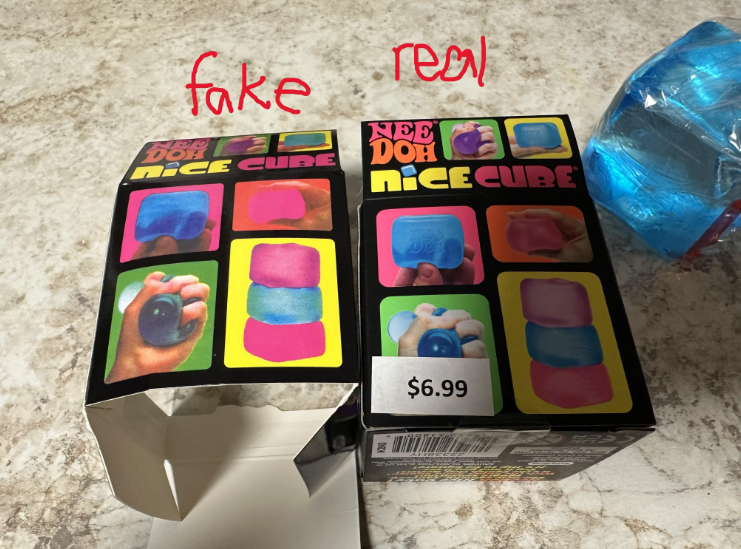
Compare the box closely: Real NeeDoh packages are sturdy and printed with high-quality spot colors.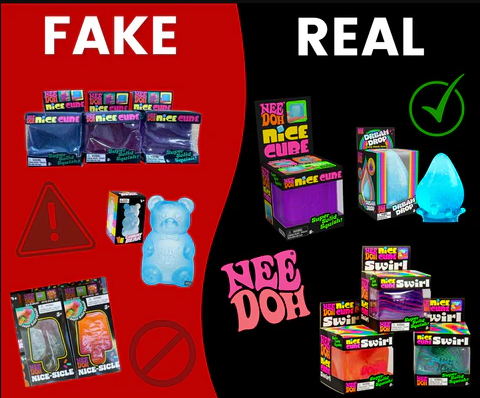
3. Feel it Before You Trust It
Texture is where fakes struggle the most. A real NeeDoh gives a firm, doughy squish that slowly returns to shape, closer to memory foam than a water balloon. Fakes often feel sticky or oily on the outside, too soft and jelly-like, or have trapped air bubbles and dents that don't bounce back properly.
4. Check the Base of the Toy
Our units usually carry a logo near the seal on the underside, with the Schylling name printed or molded close by, though not every toy prints the word NeeDoh on the bottom. A logo alone isn't proof of anything, though. Some counterfeit makers copy our branding onto the box or the toy itself, so treat this as one part of the check rather than the whole answer.
Note the difference in the base plug seal construction: real (clean, embossed logo) vs copy (messy glue, uneven seal).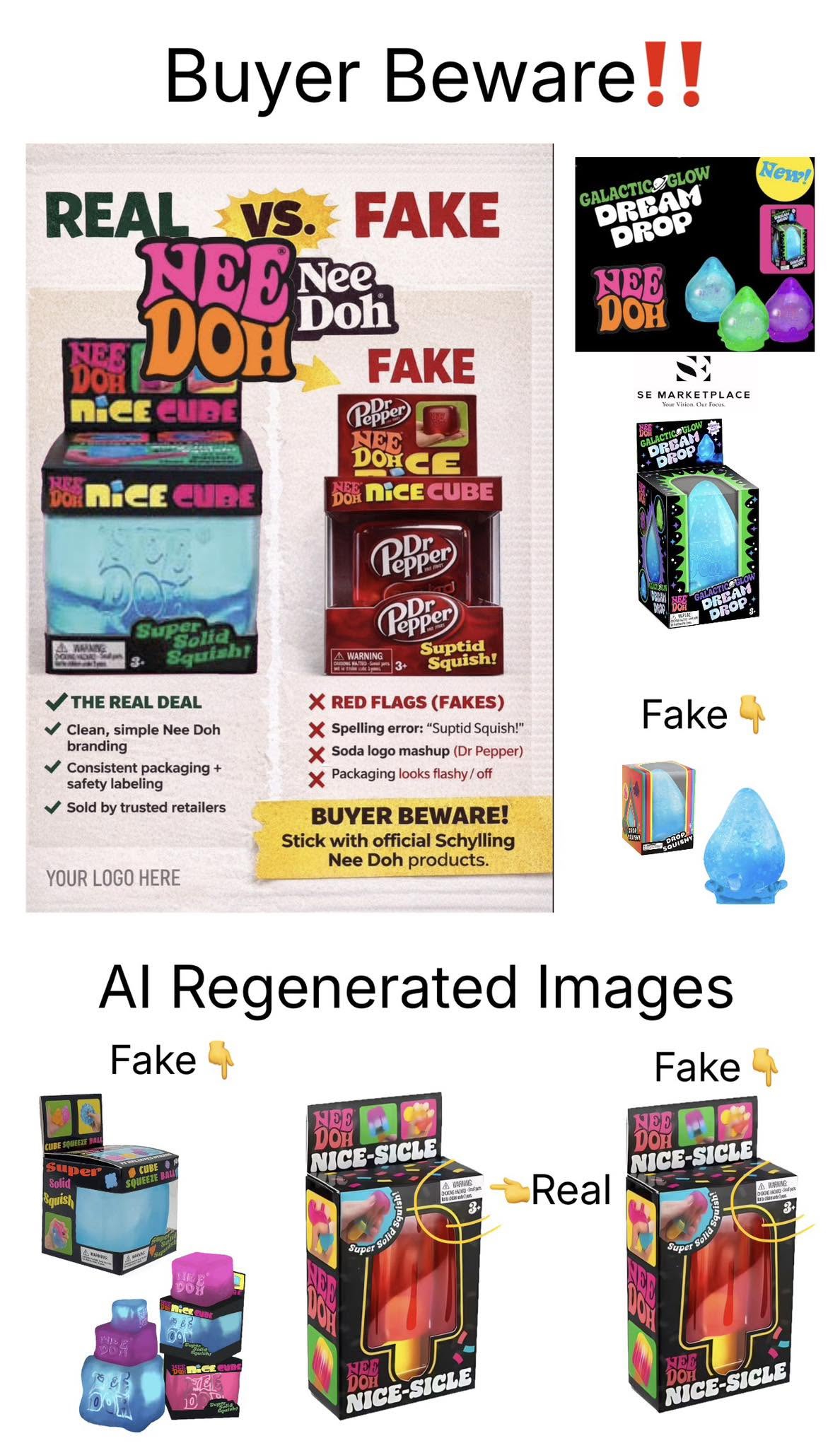
5. Give it a Smell Test
A brand new real NeeDoh can carry a faint rubber-like smell when first opened, since the material is a type of thermoplastic rubber. That smell is normal and fades after airing the toy out for a day or two.
A strong chemical smell right out of the package, sometimes described as smelling like petrol, is one of the more reliable signs you're not holding a real one.
6. Price and Where to Actually Buy
Our retail prices typically run from about $4.99 to $19.99 depending on style and size. A price far above that range is resale markup, not proof of anything real.
We've publicly warned that products sold through Temu, Alibaba, and unauthorized eBay sellers are likely to be counterfeit, and we recommend sticking with brick-and-mortar retailers such as Target, Walmart, and Staples. In the UK, Bigjigs Toys is our official distributor. Real stock in the US also shows up at CVS, Walgreens, Barnes & Noble, and Five Below.
Even on a trusted retailer's own website, check the actual seller behind the listing. Marketplace searches for "NeeDoh Schylling" can still surface sponsored ads or "similar item" placements for unrelated squishy toys mixed in with our real listings.
Viral TikTok Showcases
Check out these viral TikTok videos showing the distinction and community reviews of authentic NeeDoh toys:
Viral TikTok comparison by @missbedhead
Authenticity check by @lisi.shops
Not Every Viral "NeeDoh" is a NeeDoh
Some of the toys getting attention online aren't ours at all. There is no official Dr Pepper NeeDoh, Lululemon NeeDoh, or McDonald's Happy Meal NeeDoh in our catalog. Treat those as fan-made or fake unless we confirm a real release directly.
A Safety Note Separate from Counterfeits
This part applies to real and fake units alike. In 2026, hospitals reported burn injuries after children copied a social media trend of microwaving NeeDoh toys to make them softer, including a case where a nine-year-old in Illinois was hurt when a microwaved Nice Cube exploded.
IMPORTANT WARNING: Heating, freezing, or microwaving any NeeDoh product is dangerous. We've added safety warnings to our packaging and worked with TikTok to remove videos showing the trend. Never heat any squishy toy in a microwave, no matter what a video claims.
If You Already Have One and You're Not Sure
Don't hand it to a child until you've checked it against the points above. If you bought it online, ask for a refund, report the listing as counterfeit, and take photos of the box, the base of the toy, and the texture in case the seller or retailer asks for proof. You're also welcome to reach out to us directly if you want us to help confirm whether something is genuine.
Watch: Sensory toy review detailing real vs fake products.Common Questions People Ask
Is every NeeDoh sold at Target or Walmart guaranteed real?
Stock sold directly by the store is reliable, but both retailers also host third-party sellers on their websites, and fakes have turned up through those listings too. Check the actual seller name, not just the store name in the web address.
Can a fake still have the Schylling or NeeDoh name printed on it?
Yes. A counterfeit maker can print any name they want on a box. That's why one detail, like a logo, is never enough on its own. Check the packaging, texture, smell, and seller together.
Why does a real NeeDoh still have a smell when first opened?
The filling is a rubber-based compound, and a very mild smell right out of the package is normal. It should fade within a day or two. A strong chemical smell is the actual warning sign, not a mild one.
What is actually inside a real NeeDoh?
We use combinations of food-grade maltose sugar, polyvinyl alcohol, and cornstarch depending on the style, and every toy we make is non-toxic and free of BPA, phthalates, and latex.
Are Dr Pepper, Lululemon, or Happy Meal NeeDoh toys real?
No. None of these appear in our catalog. Treat them as fan-made items or fakes unless we confirm a real release.
Is it safe to microwave a NeeDoh to make it softer, as some videos show?
No, never, for real or fake units. Heating, freezing, or microwaving a NeeDoh can cause it to explode and cause burns, and we've worked to get that content removed from social media.
The Fast Check
A few things catch most fakes right away. The listing or box should say Schylling by name, spelled correctly. The packaging should be printed retail artwork, not a plain bag, with sharp printing and no blurry logos. The toy itself should squish and slowly spring back like memory foam, not feel sticky, oily, or full of trapped air.
A fresh unit may carry a faint rubber smell that fades in a day or two, but a strong chemical or petrol smell right out of the package is a warning sign. No single check is proof on its own. Run through all of them before you trust a listing.